

Amazon FBA allows you to reach 300 million+ customers around the world, and lets Amazon handle the storage, packing, and shipping for you. But “How profitable is Amazon FBA in 2025?” and “Is Amazon FBA still profitable in 2025?” depends entirely on selecting the right products, controlling costs, and optimizing your metrics.
However, due to even new fees, stricter requirements, and standards, profit in 2025 will depend on selecting the right product, calculating costs properly, and monitoring metrics closely. You’ll learn how to account for all fees, identify product verticals, and optimize product listings and ads.
In this article, we’ll show you the steps to build consistent income and answer “Is Amazon FBA worth it?”’
Why Use Amazon FBA in 2025? Pros & Cons
If you were to look for a better eCommerce solution for storage, packing, and shipping, you would likely be unsuccessful. Amazon FBA puts you in the position of product finder, brand manager, and marketing driver.
FBA is expected to offer access to more than 300 million active customers globally by the time this post is published. If you’re considering different fulfillment options, our analysis of Amazon FBA vs dropshipping demonstrates how Amazon FBA’s Prime qualification and operational logistics are positively compared to dropshipping models that generally have less overhead, but lower speed.
Continued use as Amazon FBA. As always, you will have to be careful, as there will always be extra fees and constantly changing performance requirements.
The report here will rely on realistic data and straightforward examples. Once you finish reading, you should have a better sense of costs and the next steps to profitably operating an FBA business.
The Reality of Amazon FBA Costs: Fees, Storage Fees & Hidden Costs

There is more to Amazon FBA than simply a shipping fee.
You will have per-unit fulfillment fees, monthly storage fees that rise in the peak months, and hidden costs for return processing, long-term storage, and inventory removal.
Understanding all of these fees is important to price your item and to protect your profit.
Amazon FBA Fulfillment Fees (Rates for 2025)
Amazon will charge a fulfillment fee for each unit received. The fulfillment fee pays for picking, packing, and sending.
Standard-size items typically pay the standard fee of between $3 and $6. For oversized items, the fees are larger.
You will also pay a monthly storage fee, which also varies by volume and season. Typical monthly storage fees are between $0.75- $2.40 for each cubic foot.
Storage fees are a bit tricky.
You will be charged storage fees at significantly higher rates from October until December. So it is important to know what your stock levels will look like to avoid the high storage fee charge during this period.
Hidden Costs: Returns, Long-Term Storage Fees, & Removal Fees
Most sellers are at risk of losing money on returns, and it can cut your profit margin in half when related shipping costs are accounted for. So that’s why many of them wonder if Amazon FBA is still profitable.
The standard fee for long-term storage is charged on anything that has been in the Amazon Fulfillment Center for over 180 days and is double the normal rate.
Can note this can eat into cash flow on slow sellers. If you remove or dispose of old inventory, Amazon will charge you around $0.50 to $1.00 per unit. Even keeping these fees in mind when establishing your pricing model, you will always have to factor these costs in.
Maximizing Revenue on Amazon FBA: Price, Velocity & Seasonality

To increase your FBA sales, you need to maximize three levers: you have the right price, a consistent monthly velocity of sales per SKU, and you understand how to manage your inventory and ads based on demand (monthly and seasonality). These principles are core to any smart Amazon FBA strategy that balances growth with cost control.
If you have it down to price, velocity, and timing, then you will improve sales, with no more cash tied up.
How to Set Profitable Prices & Margin Targets for FBA
Begin with the product cost plus the shipping to Amazon. Multiply that amount by three to four times that value for your basis Amazon FBA profit margin calculation.
This allows some overhead value to cover costs/fees/profit. Remove the FBA fees to see your margin. For example, if your product costs you $5, including shipping, you should price your product at a minimum of $15. A/B test small batches to expand the margin strategy.
Increase or decrease the price based on sales feedback and behavior. To improve margins further, check out our tips on how to get cheaper FBA fees.
Sales Velocity Benchmarks: Unit Types Per Month by Category
Tracking your Amazon margins on products is beneficial in forecasting revenue.
Electronics sellers typically have a sales velocity of 50-100 units per SKU per month. Health and beauty sellers typically sell 20-40 units.
New niches may sell fewer than ten units. Use Helium 10 or SellerApp and get current velocity. Remember that in order to manage fixed costs, your needed sales per month is a minimum of 20 units.
Balancing Peak-Season vs Off-Season FBA Sales
Sales will peak during the Q4 holiday shopping season. During this period, sellers are generally seeing a 100% increase over their sales levels relative to Q1.
If sellers want to meet demand, send ahead and ship extra stock in September. Off-season months (for example, January and July) can dip anywhere from 30-50% so reduce advertising because sales need to be controlled.
Focus on lean inventory runs to keep storage fees to a minimum.
Basic Profitability Indicators for Amazon FBA Sellers

To run a profitable FBA business, you’ll want hard numbers, not estimates.
You’ll want to track net profit margin to see what you’re making, calculate ROI to see how fast your investments are working for you, and use break-even analysis to find out your sales goal.
Do a comparison of ACoS and TACoS to determine ad effectiveness and how it affects your overall revenue.
Net Profit Margin & ROI for FBA Products
Net profit margin is net profit divided by revenue. If sales total $1,000 for a total profit of $200 after all expenses, your net profit percentage is 20%.
When doing your plans, hopefully, your net profit margin can be 15-30%.
ROI is a good way to see how quickly you are recovering your asset cost for inventory. If you purchase $1,000 and in 2 months make $200 profit, your ROI is 20% for that two-month period.
Break-even Analysis & Cash-flow Timeline for FBA
Break-even analysis provides you with how many units you’ve needed to sell to make back all your costs (product, shipping, FBA fees, advertising).
If you purchase a product for $10, sell it for $20, with $6 in fees, that means you profit $4 with each sale. With a $1,000 investment, you need to sell 250 units just to break even.
You can also map out a cash-flow timeline. You will have your inventory delivered to Amazon within one week. Sales and payouts will take another two weeks, which means you are looking at a cash cycle of four to six weeks.
ACoS vs TACoS: Measuring the Effectiveness of Your Amazon Ads
ACoS is your ad spend divided by ad-driven sales. If your ACoS is 25% then you spent $0.25 on ads for every dollar of advertising-driven sales.
A lower ACoS provides you with better ad efficiency. TACoS is your ad spend divided by total sales.
TACoS indicates the extent to which your ads concretely increase your overall store revenue. A TACoS of 10% means a fairly healthy contribution to overall sales from ads.
Market trends for Amazon FBA in 2025: user saturation, niches, buyer behavior
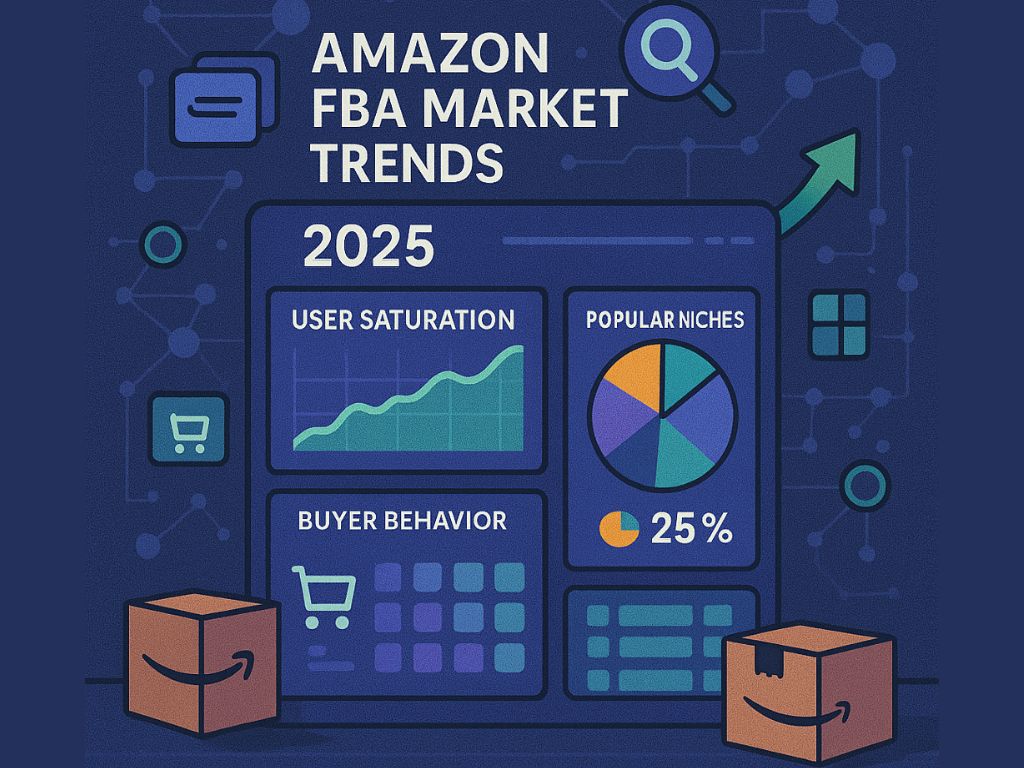
By 2025, Amazon’s marketplace will experience rapid growth, and at the scale our industry is experiencing, we will be more focused on competition in many of the major categories, while the niche categories will unveil new opportunities.
Consumer Buyers will expect fast delivery and exhibit eco-friendly products as well as subscription options.
Finding underserved niches and staying relevant with shifting consumer behaviors will be able to drive profits for your FBA.
Read more: Affiliate marketing trends 2025
Market Saturation & Finding Profitable FBA Niches
There is a lot of saturation in the major categories. For example, if you sell plastic spatulas next to 5,000 other similar products, you are going to have to outrun competitors with higher spending to get sales.
A narrow niche, say compostable silicone spatulas with biodegradable handles, to narrow down a group of at least 100 listings with healthy monthly search volume, allows you to have space to create a pricing structure to cover fees and ads, while still enticing buyers.
First, complete preliminary broad keyword research and look to see if I can find broad terms that have at least 1,000 monthly searches but have less than 200 total results on seller tools, which will allow segmented areas to yield return margins of 20-30 percent higher and lower customer acquisition costs.
Post-Pandemic Buying Behavior: Speed, Sustainability & Subscriptions
Today’s shoppers demand speed & sustainability. Over 75% of Amazon customers won’t pay for two-day shipping; it’s an expectation, not a privilege.
Concurrently, roughly 60% of consumers say they will pay more for eco-friendly packaging or established carbon offsetting.
Subscription models have skyrocketed recently, and categories like pet supplies, vitamins, and grooming products see their repeat orders at a rate of 20-30% with auto-shipment programs.
To benefit from this, display fast handling times in your listing and market any sustainable credentials. If you can promote a subscribe and save function, you’re able to lock in recurring revenue while conserving ad spend over time.
2025 Fee Changes & 3PL Strategies to Stay Competitive
Amazon increased fulfillment costs about 5% for standard items, raising the average per-unit fee to around $4.20, in January 2025.
Storage fees increased an average of 2% in April, and peak rates increased to $2.40 per cubic foot. These fee increases tighten margins and cause many sellers, especially sellers of standard items, to rethink how they ship products.
Some third-party logistics providers (3PLs) offer regional warehousing, so if you are shipping larger volumes, your fees can be 15% less than those of FBA. Multi-channel fulfillment, which is when a seller uses FBA for their Amazon orders, but uses a 3PL or fulfilled by the merchant for all of their other channels, is also gaining traction.
Many smart sellers are rebalancing between these methods every quarter just to stay competitive on price while still not losing too much profit.
Real-World FBA Benchmarks: Hobbyist vs Professional Seller Data

With real-world data, we see significant differences between hobbyists and professionals.
Hobbyist sellers typically start two or three simple SKUs, invest around $600 in inventory per month, and profit $300-$500 a month.
They break even around two or three months later and get there with pretty low sales velocity, such as 30-50 units sold per SKU per month. On the other side of the aisle, professional sellers manage 20 or more SKUs under private labels, invest about $5,000-$10,000 a month, and sell at a more consistent rate of 100-200 units sold per SKU.
From there, they utilize higher ad budgets and better sourcing for their product, consistently netting $5,000-$10,000 a month, and often getting their initial investment back in the first month.
Overall, about 60% of new FBA businesses break even/start making a profit within six months, which means about 40% exit before achieving break-even or profit, usually for problems like under-capitalization, policy violation, or unsuccessful product-market fit.
Examples: Part-Time Hobbyist vs Full-Time FBA Pros
Let’s look at Jane, a hobbyist, who sources sustainable kitchen sponges and sells three SKUs, spending $600 a month on inventory.
She has a 40-unit monthly sell-through across all her items, allowing her to net $350 after fees and ads. After about two months, Jane recovers her original investment.
Now, compare that to Apex Brands, a professional seller of branded consumer tech accessories. Apex launched 25 SKUs, sourced $8,000 of inventory per month, and sold 150 units per SKU.
After fees and 20% ad spend on their monthly revenue, Apex nets about $9,000 each month and usually breaks even within three weeks of each restock. Because of their strong branding, bulk sourcing discounts, and targeted ad campaigns, they’re able to be successful.
Average net margins: variable by product category (Electronics, Beauty, Home)
with margin profiles varying by category. Electronics sellers tend to run at margins of 5-12% because of competition on price and return rates.
Health & Beauty brands can run margins of 12-22% because of the frequency of purchases and brand loyalty.
Home & Kitchen products (especially with a design or sustainability component) can run at margins of 18-28%. Pet products can run at 22-32% from the subscription and niche demand.
Sports and outdoors products run at the low end of 15-25% margins. These margins assume controlled spend on advertising (with ACoS below 25%) and efficiency in inventory return.
Time-to-Profit & FBA Seller Survival in 2025
The typical seller breaks even in two to three months. Approximately 60% will break even/sell profitably within six months.
The majority of the remaining 40% will have some semblance of cash-flow issues, bad product choice, and Amazon policy violations to thank for a 40% abandonment rate within 12 months.
After two years, roughly 30% of sellers will remain.
It seems that the most common behavior of sellers that survive (beyond just breaking even) revolves around limiting SKUs to a core few, holding a working capital buffer equal to one month’s operating expenses, and being able to pivot quickly to a new product or market when conditions worsen.
Winning Sourcing Strategies for Amazon FBA Success

Effective sourcing is done at the right price, with the right quality, and at the right speed. Never get fewer than three quotes, and get samples ordered so you can assess the quality of the goods themselves.
It is worth aiming for 30-45-day lead times. You do not want to start dragging cash because of operational delays.
Always think of your MOQs; a lower minimum frees up more capital but can increase your per-unit costs significantly (potentially undermining your whole pricing plan).
Try to avoid anything over 2 lbs (lightweight), and as compact as possible to minimize fulfillment and storage costs. Finally, choose your model wisely; you may want to use private label for control and higher margins, wholesale for speed and lower risks, or retail arbitrage for the lowest amount of starting capital and rapid speed of execution.
Optimizing Amazon Listing: Best Practices for SEO & Conversions
Your listing works for you 24/7, as we have mentioned on how to optimize Amazon listing previously.
Start by putting your main keyword in a simple title (< 200 characters). Then, in the 5 bullet features, state the top features, benefits, guarantees, etc. Keep the bullet point text strong, active voice, and customer-focused: “Lasts up to 12 months” is stronger than “Can last up to 12 months.”
In the description area, use simple line-break HTML, and use secondary keywords and variable keyword phrases.
If you are brand registered, get A+ Content with lifestyle images, at least one high-res image, comparison charts, and a little branding story for trust (social proof).
For your reviews, use the “Request a Review” button that Amazon has, then send an email on top of that, and include a small insert card in your product packaging for both an honest feedback request and a call to action.
Then manage your negative reviews, and respond within 24 hours so the customer knows you care and protections your seller metrics.
Promoting & Advertising in Amazon FBA for 2025
Devote approximately 60% of your advertising budget to Sponsored Products; the majority of your sales and rankings are based on the organic rank of your product.
Use around 25% for Sponsored Brands, which will help your brand’s top of search brand presence, and around 15% for Sponsored Display for retargeting prepared prospects. Use dynamic bids that keep your top of search placements for high-value and conversion keywords, and negative keywords to eliminate clicks you cannot convert.
Use off-platform directed response ads in social media and your email list to drive targeted traffic to the landing page.
The landing page should be one page, no more than one screen. This is just a complete outline of your product, with its benefits and “Buy on Amazon” button. Make sure to monitor closely your clicks and sales, and keep shifting your budget each week to the best performing within each of your channels and ads.
Inventory Management: Tips for Better FBA Profits
Use the last three to six months of sales to forecast demand and adjust for seasonality. Set your reorder point by assuming you have two to three weeks of sale-level inventory remaining.
Automate the re-order process with RestockPro or InventoryLab. Hold 10-15% more stock than you think you need to avoid stockouts.
Stockout affects sales rank and organic sales velocity. Avoid stock-outs to use electronic methods such as inventory clearance promotions or small-load FBA removals to eliminate long storage fees of greater than $6 per cubic foot for FBA items past six months.
Consider using multi-channel fulfilment (FBM) for slow-moving or oversized items and reduce shipping fees. If you are shipping into the EU at high volume, consider using either American EU-based Pan-European FBA to reduce delivery times by ~30% and cross-border shipping fees.
The Biggest Risks With Amazon FBA & What You Can Do To Mitigate Them

Obsess over Order Defect Rate (1% and below), Late Shipment Rate (4% and below), and Valid Tracking Rate (95% and above)… getting flagged for any of these can get your account suspended.
Build a cash reserve of at least one month’s expenses for unplanned inventory or advertising expenses. You can sometimes use Amazon Lending, which offers short-term loans at 4-10% APR if you need bridge orders.
Avoid STRONGLY the temptation to add SKUs too quickly – increase your number of products, but only after your most profitable products are enlisted. Expanding too quickly can leave you with too little cash flow, unfocused selling efforts, and potentially really high storage fees.
Wrapping It Up: The 2025 Amazon FBA Roadmap
Data-driven decision-making needs to be married to disciplined implementation in order to be successful in 2025.
First, figure out all real costs for each SKU, set margin targets, and ROI targets. Source small batches and validate demand. Continue to refine your listings and ads.
Finally, scale by reinvesting profits from your winning products, not random deals you haven’t validated.
You can create a simple project timeline with sourcing dates, listing launch dates, and scaling increments. Review performance weekly, adjust your inventory and ad spend, and stay on top of Amazon policy changes!
FAQs: Answers to common Amazon FBA questions
- How much investment do I need to get started?
Most new sellers will start at $1,500-$3,500. This amount buys an initial inventory of two to three SKUs and a small ad budget.
- When do I expect to start making money?
Expect to break even in eight to twelve weeks. After that, profit usually starts sometime around months four or five of selling.
- Which category is the best and selling the best in 2025?
Niche eco-friendly home goods, specialty pet supplies, and health-and-wellness items continue to show the best margins.
- How do you deal with slow-moving stock?
You can run one-time promotions, have inventory removed through FBA removal orders, or convert slow SKUs to FBM.
- How profitable is Amazon FBA?
Typically, sellers will make a 15-30 % profit margin after resources and ad spend have been accounted for. On the lower end, part-time sellers (with only 2-3 SKUs) will only earn $300-$500 per month and break even at 2–3 months. Established brands with 20+ SKUs may expect profits to range from $5,000–$10,000 per month and frequently recover the costs of restocking in under a month. Good profits occur from managing costs and staying in niche markets.